

Attraction
Old Gasometer Association
Indoor & Outdoor
The Socio-Cultural Center of the Zwickau Region
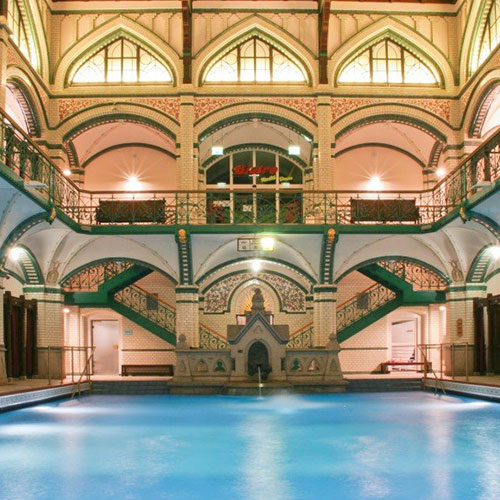
Today, the Alter Gasometer industrial monument is not only a landmark in the heart of Zwickau, but also lends a distinctive character to a wide variety of events.
Construction began in 1874. As Gasometer C, it was the third and largest gasometer on the gasworks grounds. It was completed and put into operation in 1875. Its capacity was 3,000 m³. It was built according to the bell principle, meaning that a bell-shaped structure open at the bottom was housed within the brick circular building; when fully filled, the bell extended all the way to the top. Between the wall and the gas bell there was a 75 cm wide space that was filled with water (and additionally with alcohol during the winter months). The gas was produced from hard coal, and coke, tar, and ammonia water were marketed as byproducts.
Gas was produced at this site in Zwickau until November 9, 1900. After it was decommissioned, the gasometer served solely as a storage space. Since 1994, the City of Zwickau, architects Andreas Kottusch and Michael Lotzmann, and local associations have been developing concepts for the preservation of this historic building and its future use as a community center or sociocultural center. On October 29, 1998, the Zwickau City Council passed a resolution to renovate the property.
After 15 months of construction, the building was handed over to the operator “Alter Gasometer e.V. – Sociocultural Center” on August 23, 2000. The renovation and furnishing of the property were made possible by funds from the European Structural Fund (URBAN) as well as from the Urban Heritage Preservation Grant Program by the Federal Republic of Germany, the State of Saxony, and the City of Zwickau.
Thanks to its extraordinary architecture, concerts, theater performances, variety shows, festivals and celebrations, conferences and trade fairs, readings, and arthouse cinema are set in an unforgettable setting. In addition to the Alter Gasometer event venue, the sociocultural center serves as a barrier-free and smoke-free meeting and communication space, providing a platform for various activities.
The 1,700 square meters of usable space and approximately 900 square meters of open space offer room for clubs, institutions, groups, and projects. Thus, in addition to the clubhouse, the facility houses the BuZe youth café, the music workshop and band rehearsal rooms, the Weltladen with fair-trade products, the coordination office of the Alliance for Democracy and Tolerance, the IG Stadtökologie, and Cabana e. V.
The association is a recognized provider of youth services and actively collaborates with the Jugendring Zwickau e. V. and the Landesverband Soziokultur Sachsen e.V.
The description as a sociocultural center aims to illustrate that this is an approach that offers a space of freedom to people of different ages, backgrounds, and views on life and faith. Differences should not be seen as divisive, but rather as stimulating and challenging. Cultural, social, educational, logical, and other content demonstrate a holistic orientation.
Contrary to increasing consumerism, sociocultural centers aim to enable a high degree of participation and co-creation. The programs emerge from the needs of the users; they address everyday social life, provide a framework for testing and experimentation, and have a reciprocal effect on the community. This focus on content also means that what has been achieved is not the final form, but is subject to constant change.
Directions & Contact: